There is a specific kind of watch person who reads the spec sheet for a Lorier Hydra SIII and visibly recoils at the words "hesalite crystal." That person is missing the point, and I am here to argue, gently and with sincerity, that the point is excellent.
Lorier is the Brooklyn microbrand run by Lauren and Lorenzo Ortega, and the Hydra is its dive-skewed GMT. The new SIII version slots in a Miyota 9075, which is the genuinely interesting part. For roughly $699, you get a true flyer GMT, two-tone Super-LumiNova split between local and travel time, 200 m of water resistance, and a domed hesalite crystal that will inevitably get scratched and inevitably polish back out with a tube of Polywatch and ten quiet minutes.
First Impressions
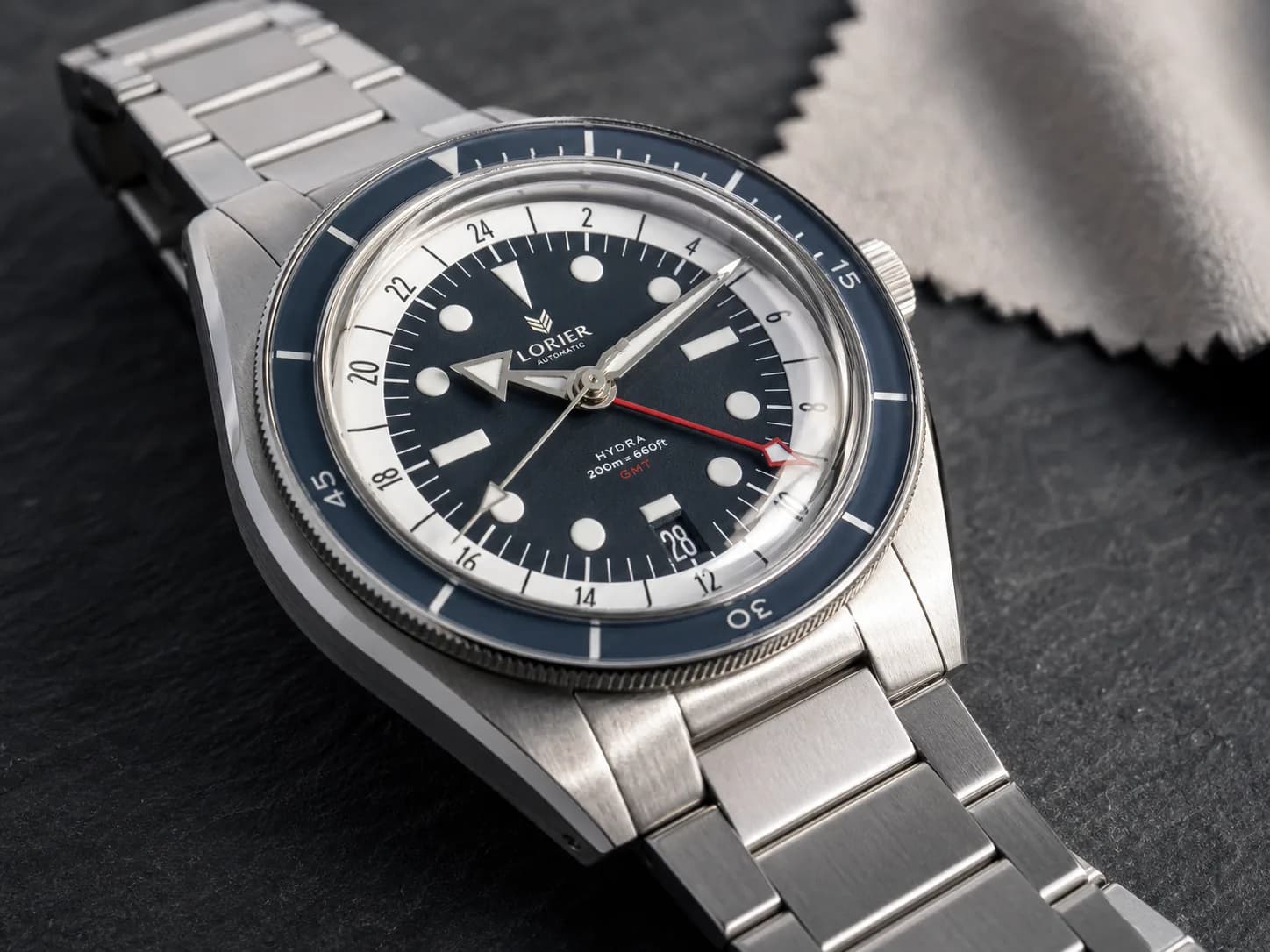
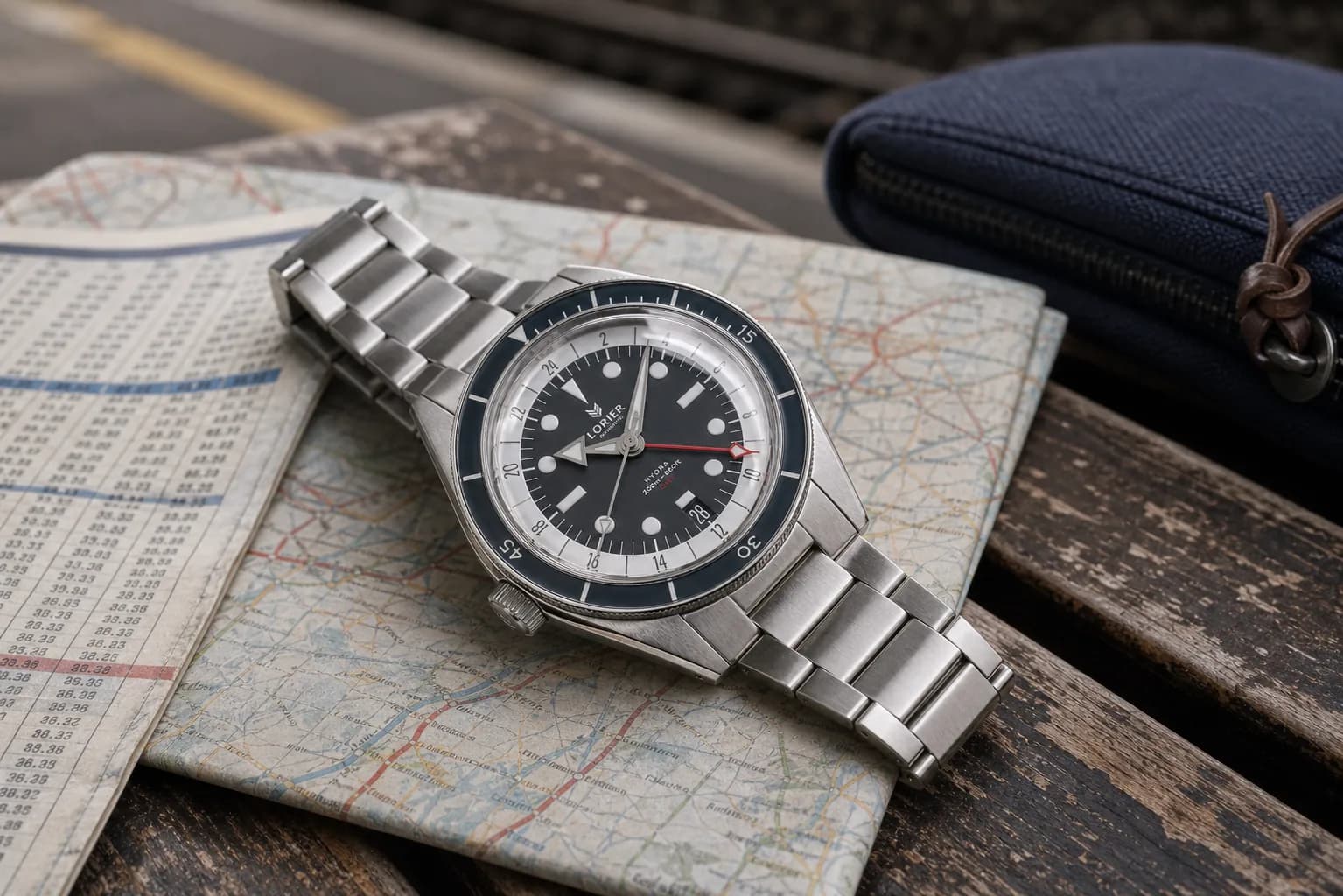
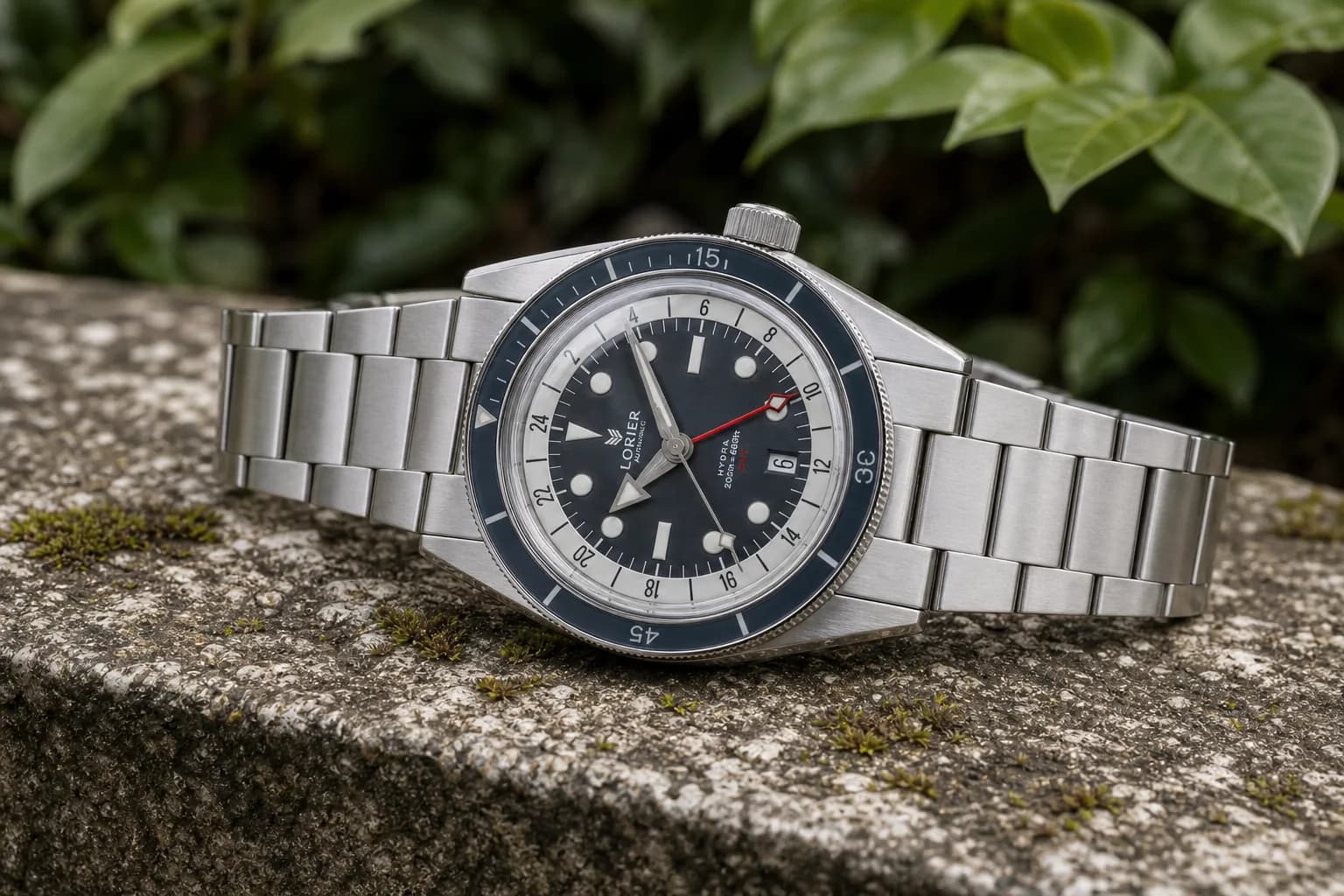
The Hydra reads as a vintage skin-diver before it reads as a GMT. That is the trick. The 40 mm case, the dome on the crystal, the matte hesalite bezel insert, the two-line text on the dial, all of it is doing a fairly convincing 1960s impression. Then your eye lands on the fourth hand and the 24-hour markings on the inner ring and you remember this thing also tracks Tokyo for you while you are eating a bagel in Greenpoint.
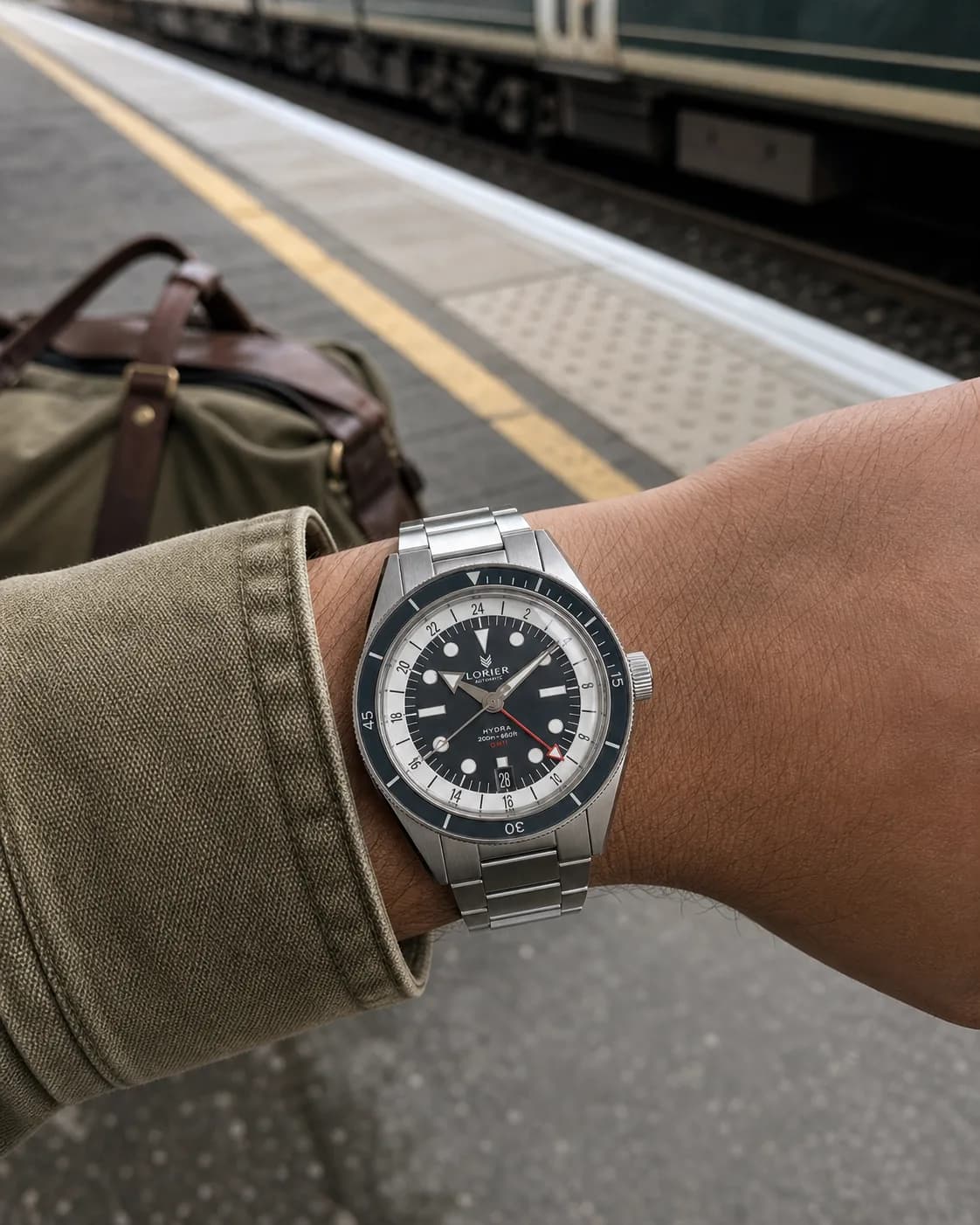
I've always liked Lorier's commitment to vintage proportions. A 40 mm GMT is the universal-fit size, the one that lands cleanly on a 6.5-inch wrist and a 7.5-inch wrist with equal grace, and the SIII does not get talked into modern sports-watch chest-puffing. It looks like a watch your grandfather might have brought back from a deployment, except it has a movement his watchmaker never could have imagined would land at this price.
Design and presence
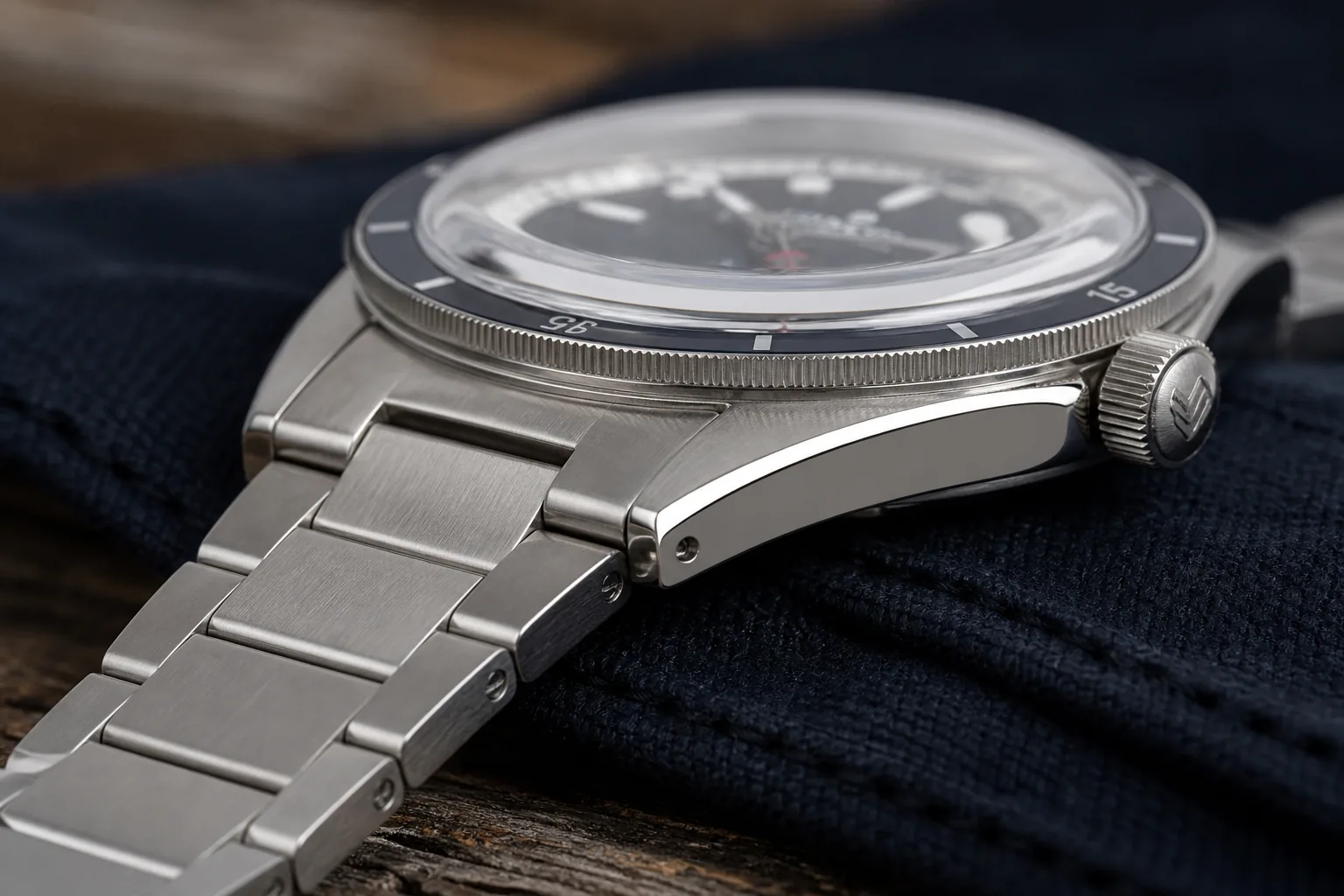
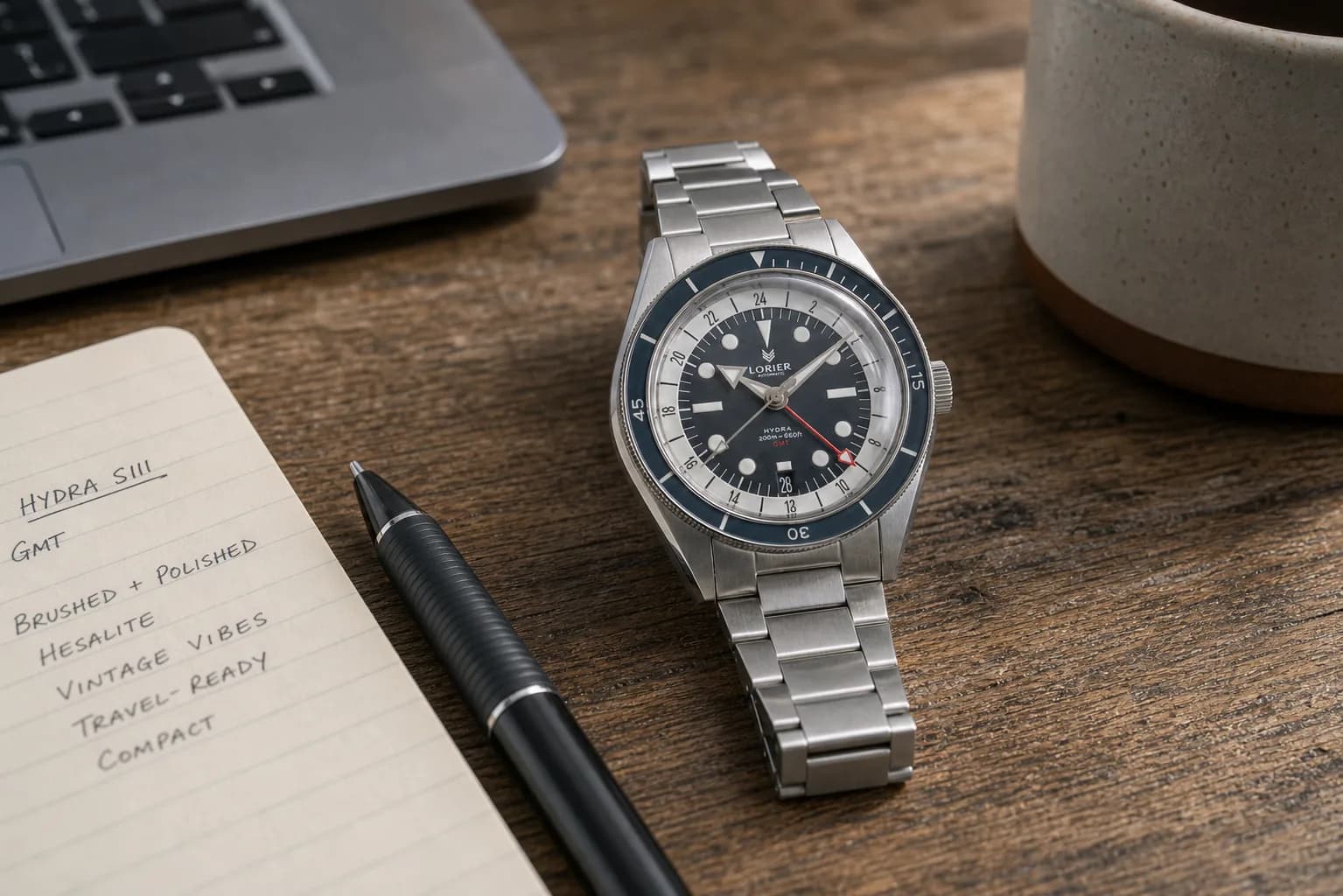
The case is brushed on top, polished on the flanks, and ends in lugs that taper rather than slab. The crown is screw-down and crisp, the bezel is a 120-click unidirectional with a hesalite insert that catches light like old plastic should, slightly soft-edged, slightly warm. There is a real thoughtfulness to using hesalite for both the crystal and the bezel, because the watch reads as one continuous material story rather than "sapphire piece + cheaper plastic insert." Either you are buying into the vintage thesis or you aren't.
The dial is the part that earns the price. Applied indices, gilt or silver depending on the colorway, with the famous Lorier two-tone lume play. BGW9 (the cool blue one) handles local time on the hands and main hour markers, and C1 (the older, warmer green-yellow) sits on the outer 24-hour ring tracking your second time zone. In the dark this is unironically clever. The home zone glows one color, the GMT ring glows another, and you can tell at a glance which hand you're reading without thinking about it. I love a piece of design that does its actual job better in the conditions where most reviewers stop paying attention.
Is the dome on the crystal too tall for some people? Yes. Will it distort the dial at extreme angles like a vintage Omega? Also yes. That is the deal you signed when you bought a watch with a hesalite crystal. If you wanted flat sapphire and zero personality, there are five hundred sub-$700 GMTs that will accommodate you. None of them look as cohesive as this one.
Wearability and the bracelet
Forty millimeters is the whole reason Lorier keeps showing up on people's lists. Lug-to-lug stays reasonable, the case wears flat thanks to a moderately slim profile, and the SIII does not feel like a pie tin strapped to your wrist the way some 41–42 mm GMTs do. The bracelet is a beads-of-rice-adjacent three-link, which has become a Lorier signature, and it tapers, which I will continue to insist is a non-negotiable for any watch trying to feel like it remembers the 1960s.
The clasp is a basic stamped affair with a fold-over and a simple safety, and it is the one place the budget shows. I'd love to see a milled clasp here, the kind with a divers' extension and a slightly nicer edge geometry, and I suspect a future SIV will get there. Until then, the bracelet itself is more than fine. It articulates well, sits closer to the wrist than the spec suggests, and pairs comfortably with the smaller-than-modern lug width if you want to swap it onto a tropic or a NATO for the weekend.
Two hundred meters of water resistance with a screw-down crown is, for the price, almost ungenerous on Lorier's part because it makes their pricier dive watches look slightly sheepish. You can swim with this. You can shower with it without writing me an email. You can also, theoretically, dive with it, but if you are doing professional saturation work I assume you are not reading watch reviews in your free time anyway.
Movement and mechanics
Here is the part that matters. The Miyota 9075 is a true flyer GMT, which means the local hour hand jumps independently in one-hour increments while the 24-hour hand keeps quietly tracking your home zone. This is the same architecture as a Rolex GMT-Master II, a Tudor Black Bay Pro, a Longines Spirit Zulu Time. It is what watch people mean when they say "real GMT" with a slightly aggressive edge in their voice.
Until very recently, this kind of movement lived in watches starting around $2,500 and going up steeply from there. The cheap end of the GMT pool was caller GMTs, which let you adjust the GMT hand independently while leaving the local hour hand to be set by the minute hand. Caller GMTs are useful, but they are not the right tool for the actual traveler use case. The 9075 changed the math in 2023, and Lorier was one of the first microbrands brave enough to slot it into something this affordable.
Specs-wise, you get 28,800 beats per hour, hacking, hand-winding, roughly 42 hours of reserve, and a date complication that is mercifully tucked at four-thirty rather than carved into the three position with a cyclops. Accuracy at the price is the usual Miyota promise, which is to say within a sensible band that will be fine in the real world and that watch nerds will calibrate against the wall clock anyway. Service intervals are generous, parts are not exotic, and the movement is already proving itself across enough other microbrand releases that we can stop calling it new.
Market context
If you walk in with a budget for a dual-time-zone tool watch and you are not constitutionally opposed to plastic crystals, this is one of the strongest options under a thousand dollars. The closest direct comparison is the Christopher Ward C65 Aquitaine GMT, which lives at roughly $1,710 and gives you Swiss provenance, a Sellita-derived caller GMT, and substantially more polished case finishing. The Hydra answers with a true flyer movement at less than half the price, which is the trade you have to weigh carefully if movement architecture matters to you more than finishing tier.
The closer Swiss option is the Mido Ocean Star GMT, which also runs a true GMT and lands around $1,150. It is a competent watch and worth its money, but it wears bigger and reads more contemporary, and it does not have anything resembling Lorier's vintage charm.
Among microbrands also running the 9075, the Boldr Venture GMT is the obvious cross-shop. It leans titanium, sportier, more adventure-explorer in styling. The Hydra leans skin-diver and Brooklyn-mod-revival. They are not the same watch, and the choice is mostly an aesthetic one. I'd argue the Hydra is the more cohesive design of the two, but Boldr's titanium pitch is genuinely seductive if you hate weight on your wrist.
Verdict
The SIII is the rare microbrand release where the spec sheet, the styling, and the price all reinforce each other instead of fighting. You are getting a 40 mm vintage-styled dive-GMT with a true traveler movement, two-tone lume that earns its keep at three in the morning when your flight lands, and a hesalite crystal that is a deliberate aesthetic choice rather than a corner cut. At $699 the value math is, frankly, almost rude.
Who should care, anyone who has been waiting for a flyer GMT under a grand and would prefer it not look like a sport-utility tool watch. Anyone shopping the Aquitaine GMT but quietly wishing it cost half. Anyone with a small rotation and a soft spot for vintage cases who wants one watch that can also do airport duty.
Who should pass, anyone allergic to plastic crystals on principle, anyone who needs sapphire because they grew up scratching watches against gym equipment, anyone who needs a milled bracelet clasp at this price tier and will not be talked out of that requirement. All fair positions, and all reasons to look elsewhere.
On its own terms, this is the most genuinely fun GMT under $1,000 right now. The hesalite is not a bug. It is the entire point.
Reader Comments
Join the discussion
0 comments
Comments may be held for review before appearing. Your name is public; email is optional and never displayed.